Update, September 8, 2026: Two things have changed since the last revision. Google switched on the opt-out control for its AI features worldwide on August 31, and there's a new section below on what it does and who should use it. And in June, Bing extended its AI Performance report with Intents, Topics, Citation Share and a period comparison; the Bing section and the workflow are updated accordingly. The Search Console generative AI report itself has been available to everyone since August 11 (see the August 21 update).
Until recently, "AI visibility" was a metric you had to guess. Since August 2026, Google gives you the real numbers, in every Search Console property.
I track AI visibility for several clients, so I have to admit: every measurement so far has been a proxy. You define a set of prompts, run them against ChatGPT & Co., and check if you get mentioned or cited. That's genuinely useful: you see who shows up for the topics that matter to you. But it answers a different question. It tells you who's visible for the prompts you chose, not whether you're actually visible for the questions your customers ask.
That missing piece is exactly what Google and Bing are now handing over.
What Google now delivers
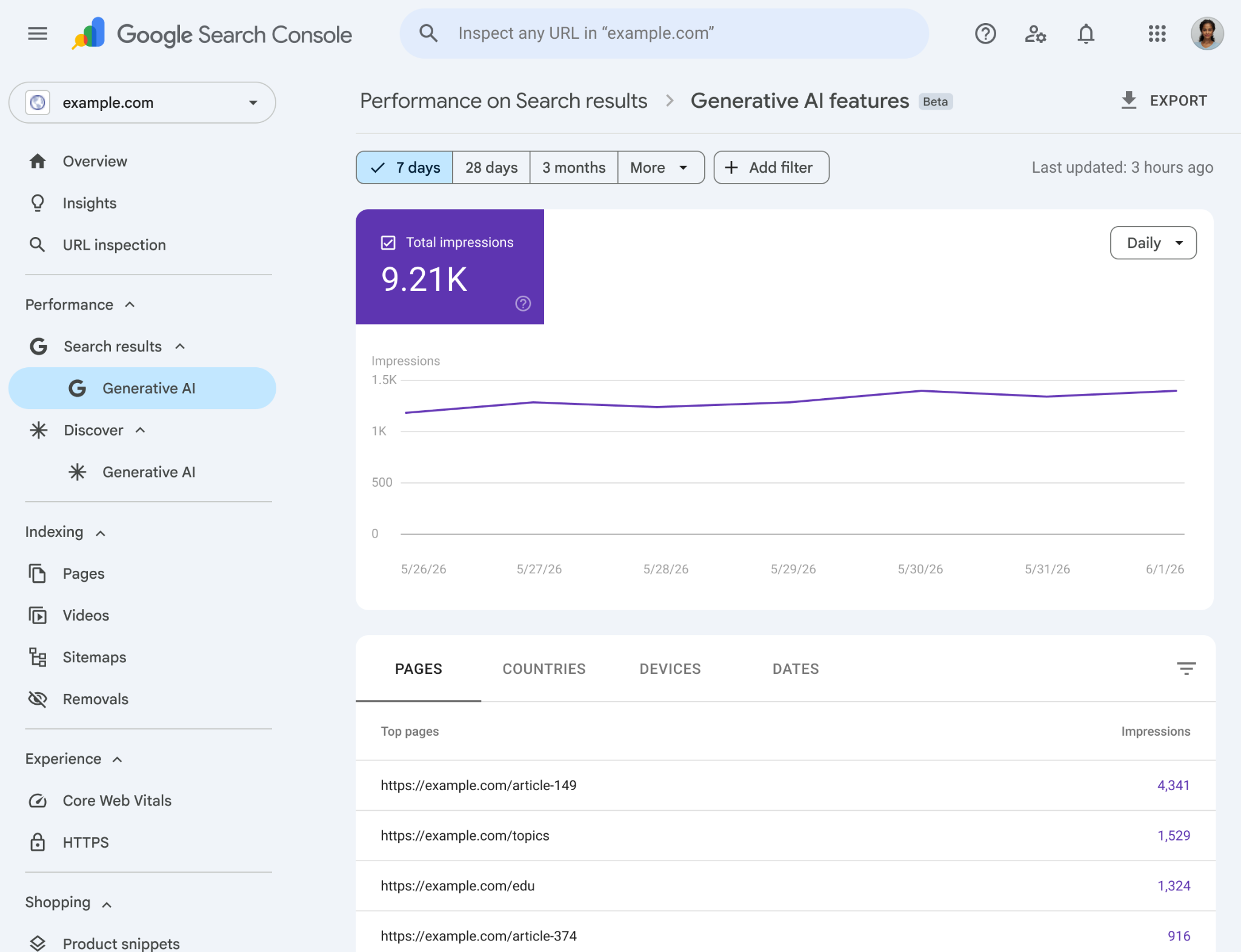
On June 3, 2026, Google introduced a dedicated generative AI performance report in Search Console, with separate reports for Search and Discover. On August 11, 2026 it was opened up to every verified property, worldwide and across all languages.
Real impressions from real user queries: how often your site appears in AI Overviews and AI Mode, which pages, in which countries, trended over time.
Two things before you open Search Console:
- It's there, for everyone. At launch on June 3 the report ran as a test with a small group of UK sites. Since August 11, every verified property finds it under Performance → Generative AI. You still need enough AI-feature impressions, and your site must be included (not excluded) in Google's AI features.
- Impressions only, no clicks (for now). No CTR, no traffic, today the report shows pure visibility.
You can segment by pages, countries, devices and dates (Pacific Time; the newest daily data can still be preliminary). The history starts on May 18, 2026, and Google backfills nothing before that. Open the report for the first time today and you'll see just under a quarter of data, not a day more.
Side note: Google announced an opt-out control alongside the report. In June it was a test with UK sites; since August 31 it sits in every property. What exactly it switches off, and who it's the right lever for, is covered further down in its own section.
What the report doesn't show
This is the part that disappoints on first open. Know it before you set expectations with your team:
- No clicks, no CTR. You see visibility, not what it earns you.
- No queries. Unlike the classic performance report, there is no query dimension. You know a page shows up in AI answers, but not what question triggered it.
- No split between AI Overviews and AI Mode. Both land in a single number, together with the generative features in Discover. Whether your impressions come from the overview above the blue links or from a conversation in AI Mode, the report won't tell you.
That's enough for the first question ("is my site collecting AI visibility at all?"). It's not enough for the second ("what do I work on tomorrow?").
The second control: opting out of AI features
Since August 31, 2026, every Search Console property has a second control next to the report: the Search generative AI control under Settings → Search generative AI. In June it was a test with a small group of UK sites; now it's live worldwide. Before you touch it, know what it does and what it doesn't:
- It switches off three surfaces: AI Overviews, AI Mode and the generative features in Discover. Opt out and you appear there neither as a source nor as a link, and you get no impressions from them either. The generative AI report goes blank.
- It leaves everything else alone. Classic Search and the Discover feed keep running unchanged. Google states explicitly that the control is not a ranking or inclusion signal, so you don't slip back in the blue links.
- It is not a training opt-out. Whether Google trains models on your content is still governed only by the Google-Extended token in robots.txt. And ChatGPT, Perplexity and Co. don't care about this control at all.
- It works per property and is reversible. Domain, subdomain and URL-prefix properties can be set individually or inherit the parent property's setting. After flipping it, Google says it generally takes a few days for content to disappear. You can revert at any time.
Which leaves the question of whether you should pull it. For the vast majority of B2B sites, the answer is no. Being cited in AI Overviews doesn't cost you, it puts you ahead of everyone who isn't cited: Seer Interactive analysed over 3,100 search terms across 42 organisations and found 35% more organic clicks and 91% more paid clicks for cited brands compared to uncited ones. AI Overviews push overall click-through rates down, yes. But opting out doesn't win those clicks back; it just puts someone else in the answer.
The control makes sense where the AI summary replaces the visit and the visit is the business: paywalled publishers, databases, content that pays for itself per reader through subscriptions or ads. If your website generates leads through consulting, software or services, you want to be in the answer. That's where buying research now starts.
Bing has something Google still doesn't
Google has caught up, but Bing Webmaster Tools has held one data point since February 10, 2026 that Search Console still lacks: AI Performance shows not just how often your pages are cited in Microsoft Copilot and Bing's AI answers, but which search phrases got them there.
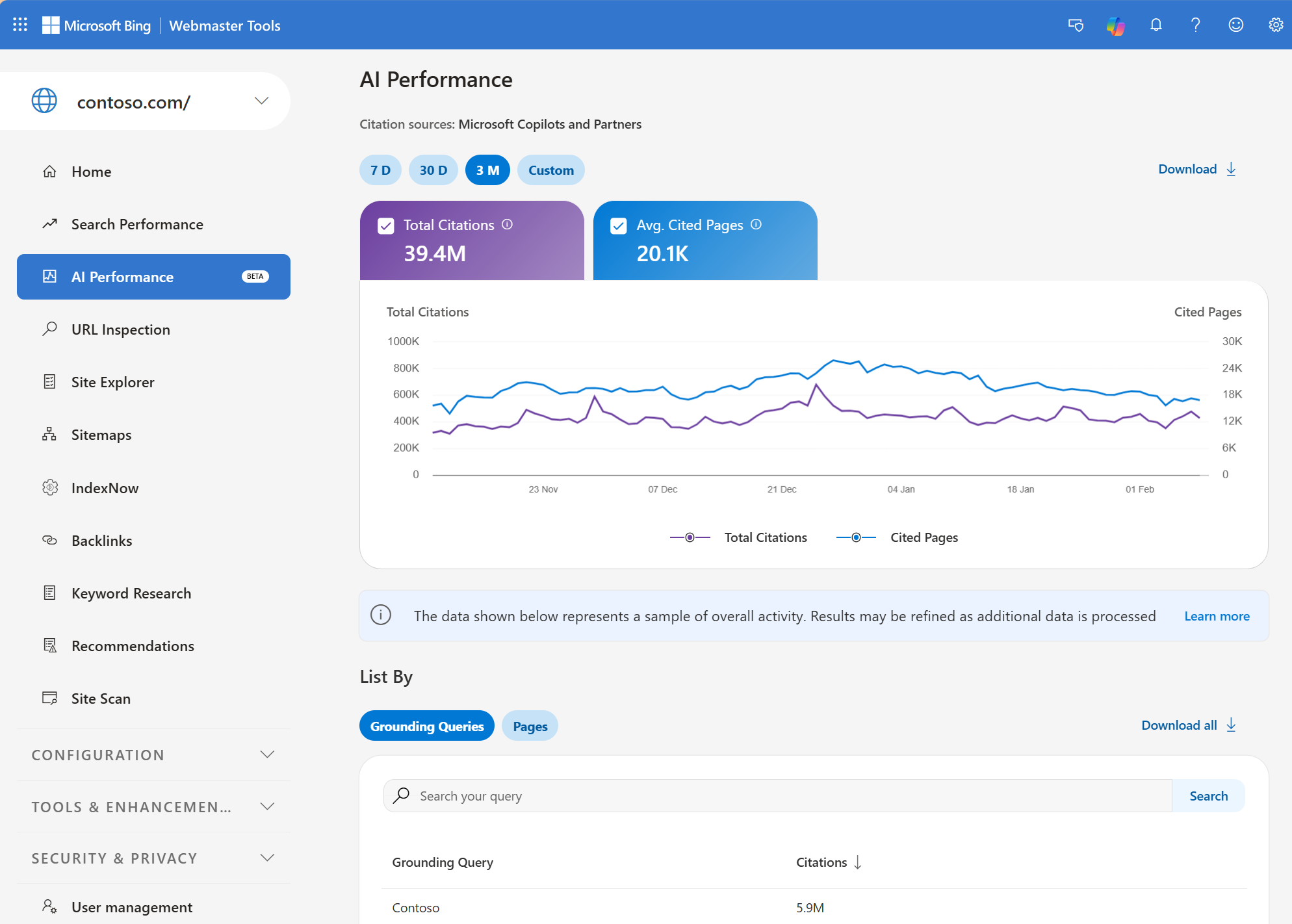
Those are the grounding queries: the search phrases the AI actually used to find and cite your content. Exactly the dimension Google's report leaves out. Concretely, since the February launch you get:
- Total Citations: how often your content appears as a source in AI answers overall
- Average Cited Pages: how many unique pages get cited per day
- Grounding Queries: the phrases the AI used to pull your content
- Citation activity per URL: which pages get cited, trended over time
Since June 16, 2026, four dimensions have been added, all still in preview and rolling out globally:
- Intents: grounding queries grouped by intent: Informational, Commercial, Navigational, Learn and Solve, Research, Creation, Local. Shows whether the AI pulls you for buying research or only for explainer questions.
- Topics: related grounding queries clustered into themes, so solar panels, solar energy efficiency and residential solar installation land in a Solar Energy cluster. Shows where the AI treats you as an authority and which topics are missing. For niche domains, Microsoft admits the labels are still broad.
- Citation Share: your share of all citations shown across all sites for a given grounding query. Purely observational: no competitor domains, no traffic share, no quality scores.
- Compare: a previous period overlaid on the current view, with custom date ranges. Finally, a content update can be held cleanly against the 30 days before it.
One caveat: the data is a sample of overall citation activity, not a complete count. Even so, it's the first thing that gets closer to "real user behavior" than anything before it. Underrated for B2B, where buyers sit inside Microsoft tools all day.
And this isn't theoretical: for one client we 10×'d their AI Performance according to Bing, today they get roughly as many leads from Bing as from Google. In B2B, Bing is still very much relevant.
How to approach it
No new tool, no setup marathon. The order:
- Open the Google report. Search Console → Performance → Generative AI. Since August 11 it's in every verified property, with data back to May 18. First question: which pages collect AI impressions at all, and do they match the ones you bet on?
- Add Bing. Open Webmaster Tools → AI Performance. That's where the data point Google doesn't have lives: grounding queries, the real questions you're being cited for. Intents and Topics pre-sort them for you: buying research or explainer question, and which topic cluster.
- Hold grounding queries against your prompt list. This is where it gets interesting: compare the questions you're actually cited for with the prompts you invented for your GEO tracking. The gap between them is your to-do list.
- Prioritize the cited pages. Which URLs is the AI pulling? Expand exactly those, structure them cleanly, keep them current. That's your existing lever, now backed by data instead of guesswork. Citation Share shows you where you're just one source among many, and Compare whether an update moved anything after 30 days.
Why this is more than a new column in your dashboard
For the first time, you can work on your AI visibility and verify it against actual user behavior: not a self-selected sample.
Prompt-based tracking stays useful: it's the only way to look right now into ChatGPT, Claude & Co., which have no Search-Console equivalent yet. But from here on you have a ground-truth layer next to it for Google and Microsoft. Proxy plus reality, instead of proxy alone.
Why your own tracking stays indispensable
Don't get me wrong: Search Console and Bing are a leap forward. But they have blind spots that matter for growth.
- They only show Google and Microsoft. ChatGPT, Claude, Perplexity & Co. appear in neither report, and that's exactly where a growing share of buying research happens.
- They show that you're cited, not how. Were you named as a recommendation or as a cautionary example? In what context, next to which competitors, with what sentiment? An impression tells you none of that.
- They show no competition. You see your own numbers, but not who's taking citations from you and for which topics. Bing's Citation Share at least tells you what share of a query you hold, but not who gets the rest.
That's exactly why we built our own tracking tool at Fento AI. The existing solutions weren't enough for us to actually hack growth through AI visibility, they measure mentions, but they don't close the loop to "what do we do differently tomorrow." We track across every relevant AI engine, break it down by sentiment, context and competitors, and merge it with the real numbers from Search Console and Bing. Proxy and ground truth, in one place, translated into concrete action.
Which leaves the question of whether, and when, something similar will show up for ChatGPT, Claude & Co.
If you'd rather not build this layer yourself: I take over measuring and optimizing your AI visibility end to end, for B2B teams in Munich, Berlin and Zurich.
Sources: Google: Generative AI performance reports in Search Console · Google Search Console Help · Search Engine Roundtable: Generative AI report live for all · Bing: AI Performance in Bing Webmaster Tools · Bing: Intents, Topics, Citation Share and Compare · Google Search Console Help: Search generative AI control · Search Engine Land: AI reports and opt-out control rolling out globally · Seer Interactive: AIO Impact on Google CTR