When someone asks an AI a question today, it doesn't become one search. It becomes several. The user types a sentence, the system turns it into its own set of searches, and only their results become the answer. Visibility is no longer decided at the question. It is decided at those searches.
Those self-generated searches are called fanout queries, or subqueries. Google introduced the term itself at I/O 2025. Elizabeth Reid, Head of Search, described AI Mode this way: the system breaks the question into subtopics and issues a multitude of queries simultaneously on the user's behalf.
The definition now sits in Google's developer documentation too. Fanout there is a set of concurrent, related queries generated by the model to fetch additional relevant results.
What happens between question and answer
The sequence is essentially the same across the major systems. We built it as an explainer video, using ChatGPT as the example:
Four steps, and your page can drop out at every one of them:
- Fan out. The user question becomes several subqueries. Robby Stein, VP Product at Google Search, explained it with an example: asked about things to do in Nashville with a group, the system thinks up its own questions about restaurants, bars and things to do with kids, and then starts googling.
- Search. Those subqueries run through an index. For ChatGPT that is mostly Bing; for Google it is its own systems plus the Knowledge Graph, Shopping Graph and Maps.
- Fetch. The results actually get loaded. This is the moment live readers like
ChatGPT-Usershow up in your server logs while Google Analytics never hears about it. How to make those visits visible is covered in our piece on the AI bots reading your website. - Rerank. A reranker scores the retrieved passages and keeps only the best. The rest disappears. In an AirOps analysis of more than 548,000 fetched pages, 85% were never cited.
The critical point: your page does not have to match the user's question. It has to match one of the subqueries you never get to see.
So how many subqueries are there?
This is where it gets awkward, because the industry cites a lot of numbers nobody measured. "AI Mode generates 8 to 16 parallel subqueries", "Google says 12 to 15", "complex questions 50 or more": all of that is out there in blog posts, and none of it has a primary source.
Google has never published a number. The only official quantity is Reid's "a multitude". The most concrete anyone at Google has been is Dounia Berrada, Senior Engineering Director for Search, and that was about visual search: AI Mode there does roughly a dozen searches in the time one would normally take. For Deep Search, Google says "dozens or even hundreds".
What does exist is independent measurement:
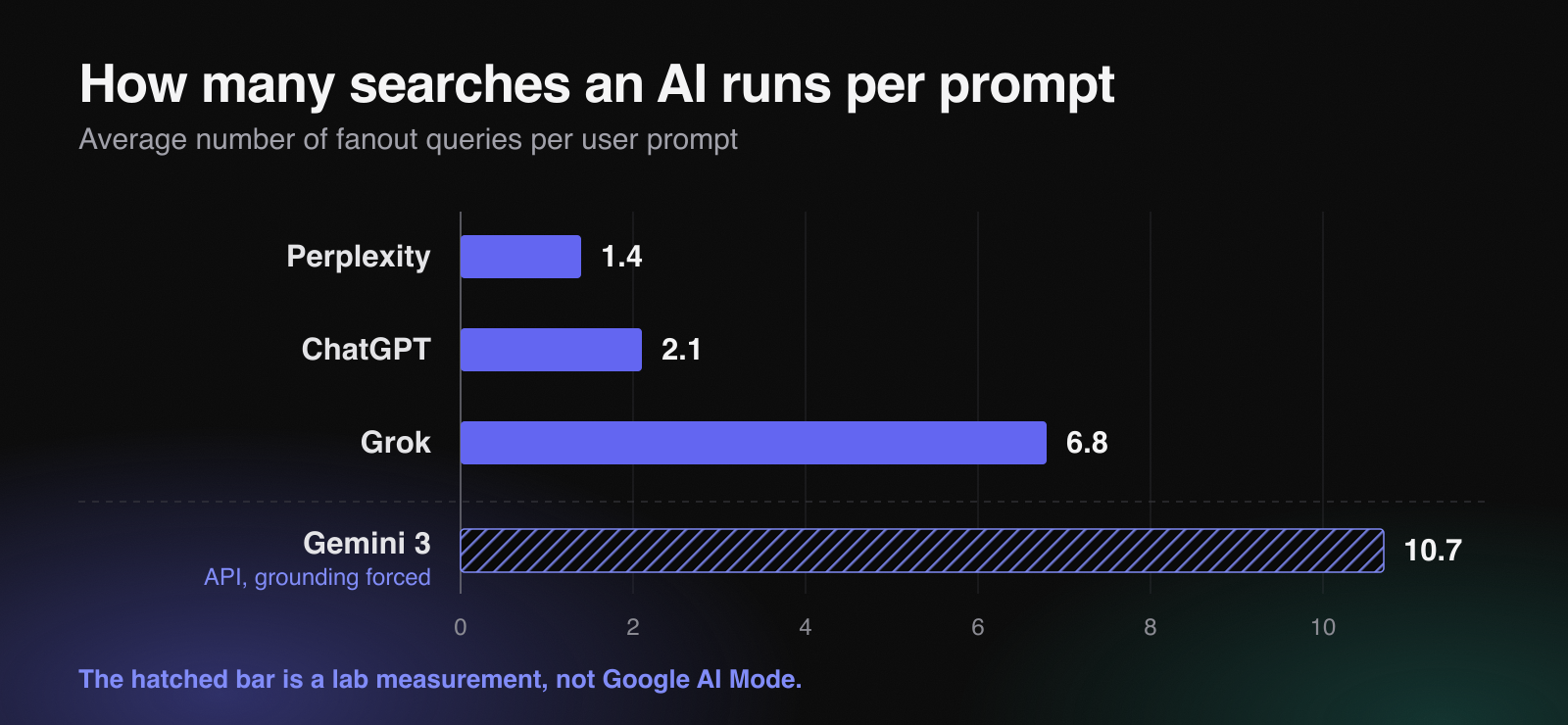
Two things matter about this chart.
First, the spread. Perplexity barely fans out, Grok does it heavily. Peec AI captured 5 million fanouts from the real web interfaces rather than through APIs, which is as close to actual user behaviour as this gets. Grok uses the site: operator in 18.3% of all chats, searching specific domains on purpose.
Second, the hatched bar. The widely quoted "around 10 subqueries for Gemini 3" comes from measurements through the Gemini API with grounding forced on. Seer Interactive got 10.7, Nectiv got 9.06 on a larger sample. The honest phrasing is "roughly 9 to 11 under lab conditions". That is not Google AI Mode, and anyone citing it as such is spreading a number that does not exist.
Trend 1: Google goes wide, ChatGPT goes deep
The most interesting development of the past twelve months is that the systems are moving in different directions.
For Google, the count went up. The same Seer test found 6.01 subqueries for Gemini 2.5 and 10.7 for Gemini 3, a jump of around 78% within one model generation. The length of the individual query stayed stable at about 6.7 words.
For ChatGPT, it is the reverse. Peec AI analysed over 20 million fanouts from October 2025 to January 2026: the count per prompt stayed flat at 2.3 to 2.8. The average length of a subquery doubled from roughly 6 to roughly 12 words, and did so almost identically across Germany, the UK, Singapore, Thailand and the US.
That distinction matters, because "fanouts have doubled" gets repeated constantly. What doubled at ChatGPT is the word length, not the count, and at Google it is exactly the other way round.
Trend 2: ChatGPT went from lookup to research
Across 2026's model changes, ChatGPT's behaviour did shift substantially, and it shifted in jumps rather than gradually.
The move to GPT-5.3 Instant in March 2026 initially narrowed things. RESONEO ran 400 prompts daily for 14 weeks and saw the number of unique domains per response fall from 19.1 to 15.2, a drop of just over 20%. Depth per domain held; breadth shrank.
With the following versions it swung hard the other way. Lily Ray pulled together the data from Peec, Nectiv and RESONEO:
- The share of prompts with only a single fanout fell from 94.0% to 43.5%
- The average number of sources fetched doubled from about 12 to 24
- Prompts with a second search round rose from around 5% to 33.5%
- The
site:operator appeared in fanouts, up from roughly 0.3% to about 23% - The average number of fanouts per prompt climbed from 2.17 to 7.61
A lookup tool turned into a research process. And one detail from that is arguably the single most useful fact in this whole topic: brands that already appear by name inside a fanout query get cited 68.9% of the time. Pages that were merely fetched, without the brand appearing in the search, come in at 2.1%. Across 27 test queries, 21 contained brand names the user had never mentioned.
Get into the search query itself, and the citation battle is largely already won.
Trend 3: fewer and fewer sources come from the top 10
The measurable effect of more fanout is that the classic results page matters less as the pool sources are drawn from. Ahrefs analysed 863,000 keyword SERPs and around 4 million AI Overview URLs for this (data from January 2026, published March 2026):
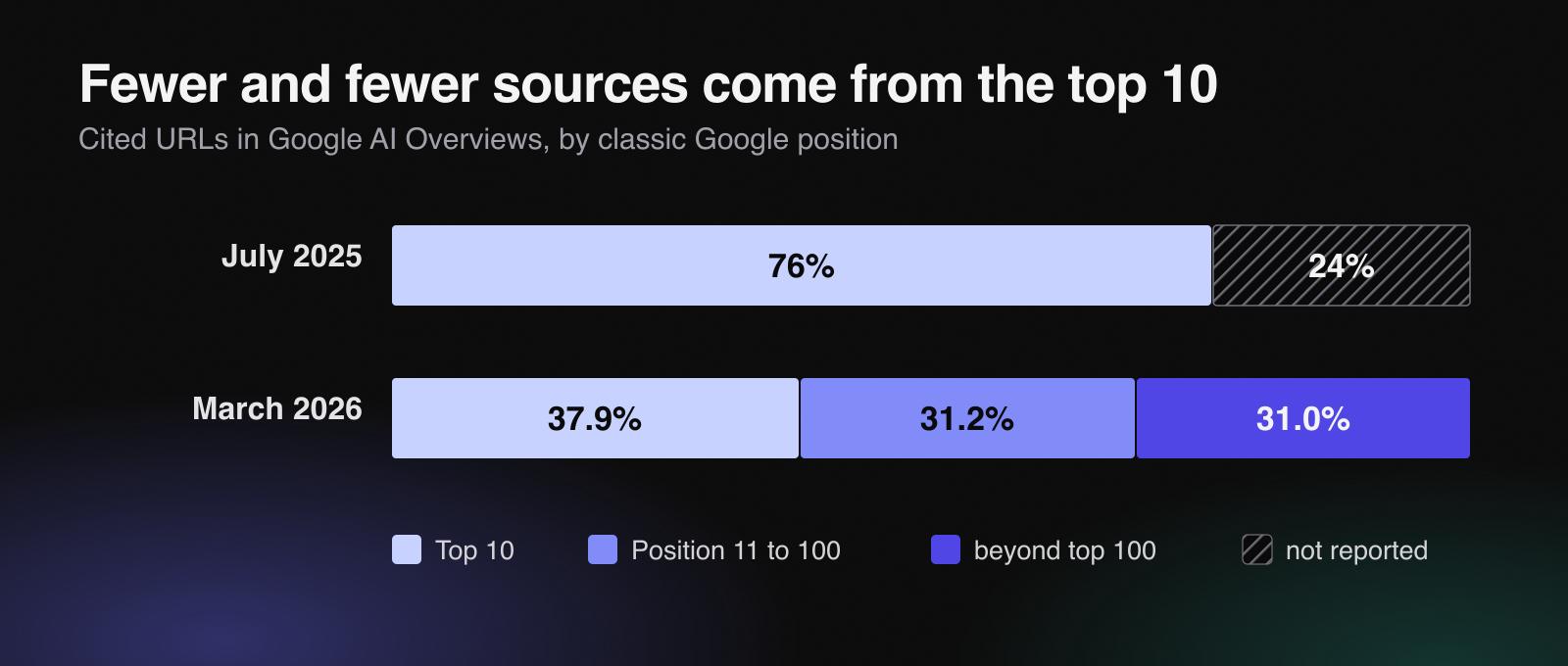
In July 2025, roughly three quarters of cited URLs ranked in the top 10. By March 2026 it was 37.9%. Nearly two thirds of sources now come from pages you never see for the head keyword. Ahrefs attributes the break to AI Overviews moving to Gemini 3 in January 2026, which is exactly the shift that also raised the subquery count.
That lines up with what AirOps measured on the ChatGPT side, across 15,000 prompts and more than 82,000 citations: 32.9% of cited pages appeared only in the search results for a fanout query, never for the original prompt. That figure gets attributed to Kevin Indig almost everywhere, but it comes from the AirOps study.
An important counterweight, so this doesn't turn into the wrong conclusion: classic ranking remains the single strongest lever. In that same AirOps analysis, pages at Google position 1 had a 43.2% citation rate; beyond the top 20 it was 12.3%. Fanout does not replace SEO. It enlarges the surface SEO operates on.
The point most non-English companies are missing
Now the finding that carries the most practical weight if your market isn't English-speaking.
Peec AI examined over 10 million prompts and more than 20 million fanouts to see which language the subqueries run in. The result: 43% of all fanout steps on non-English prompts are in English. Around 78% of all non-English prompt runs contain at least one English fanout. The pattern is usually the same: the first fanout stays in the user's language, and further down the chain it flips to English.
Peec gives a German example in the study. For the prompt "Was sind die besten Softwareunternehmen?", not one German company appeared in the results.
What that means for you: a presence in your local language alone systematically covers only part of the surface where selection happens. For nearly half the subqueries you are not badly placed, you are not in the running at all. English versions of your core pages, meaning product, comparisons and the pages that describe your brand as an entity, have stopped being a nice-to-have.
What to do with this
First the counterweight, because there is a lot of consultant-speak forming around fanout right now. Google's own documentation states there are no additional requirements and no special optimisations needed to appear in AI Overviews or AI Mode. Structured data is not required, and files like llms.txt are simply ignored by Google Search. Fanout is a retrieval mechanism, not a new optimisation discipline.
What does follow concretely:
- Coverage, not phrasing. Only around 27% of subqueries stay the same across repeat runs according to Surfer, and 95% of measured Gemini fanouts have zero search volume according to Seer. Optimising for individual subqueries is therefore pointless. Optimising for the topic behind them is not: pages that also ranked for fanout queries were cited 161% more often in that same Surfer analysis. Surfer does sell a tool for exactly this, though, and the finding is correlational, not causal.
- Passages, not pages. What gets retrieved and scored are sections of text, not whole documents. A section should make sense on its own, without the paragraph above it.
- Serve the injected words. Fanouts systematically append terms the user never typed. At ChatGPT that is mainly
bestat 15.3%, thenwhat,reviews, the current year andvs. Comparison pages, alternatives round-ups, reviews and a visible update date therefore hit exactly the queries that actually get issued. - Get your brand into the search. See above: 68.9% versus 2.1%. Anything that makes your name show up as a search term in the first place, meaning mentions on third-party sites, comparison lists, directories and press, feeds directly into citation likelihood.
- Plan for English. See the section above.
How to make fanouts visible
Finally the practical question: can you see which subqueries reach you? Partly. And the tooling splits into two groups that should not be confused.
Simulated. Tools like qforia by Mike King have a language model invent plausible subqueries. That is usable for a content brief. It is explicitly not what the machine actually searched for. The same applies to queryfanout.io and Semrush's Prompt Research report.
Observed. Here real queries are captured. Profound has recorded fanouts from its own daily prompt runs since October 2025, Peec AI since July 2026, and Ahrefs Brand Radar shows them for ChatGPT and Perplexity.
Among the search engines, the situation is the opposite of what you would expect. Google's generative AI report in Search Console has delivered impressions only since June 2026. No clicks, no CTR, no position and above all no query dimension. Search Console is unlikely to ever show subqueries, not least because with fanout a single user request pulls content from many URLs into one answer, so the attribution is no longer clean.
Microsoft, of all companies, is ahead here. Bing Webmaster Tools has shown grounding queries since February 2026, meaning the searches Copilot used to retrieve content that then got cited. Query-to-page mapping arrived in March, and June added intents, topic clusters and your share of the citation space per query. No API, only a sample, but it is the one free source of real retrieval queries. If you want to start somewhere today, start there.
One word on how durable such access is: ChatGPT removed its subqueries from the web interface with the move to GPT-5.3, browser plugins stopped working, and the community found new routes a few weeks later. This is cat and mouse. Do not build your measurement on a bookmarklet.
What holds
Fanout is not a new optimisation discipline and not a trick. It is a description of what happens between question and answer, and it shifts three things.
The surface gets bigger. Instead of one keyword, several invisible subqueries decide, three quarters of which change on every repeat run. The results page loses its monopoly as the selection pool, from three quarters down to just over a third in eight months. And the language boundary has become permeable, in a direction that does not favour companies publishing only in their local language.
What stays the same: whoever has the best answer to the questions surrounding their topic, written in sections that also work on their own, wins in both worlds. That is exactly what we work on with B2B companies, as a GEO agency for Munich, Berlin and Zurich.