In 2026, customers no longer arrive through a single ranking. They arrive through a loop: get the basics right once, then learn what buyers ask, answer it on your own site, let others vouch for you, measure, repeat. Keep the loop running and you become the recommendation, in Google and in ChatGPT.
Almost every marketing lead asks us the question in the title during a first call, usually in one of two moods. Either organic clicks have dropped and nobody knows whether the site or Google is to blame. Or there is a mandate from above to "do something with ChatGPT", without anyone being able to say what that should concretely be.
This post is the answer we give in those conversations. First a look at the situation, then the six layers that decide in 2026 whether your website brings in enquiries.
What changed in 2026
Three numbers are enough to describe the situation.
The users are there. Google's AI Mode, available in Germany since 7 October 2025, has more than one billion monthly active users according to Sundar Pichai in July 2026. ChatGPT reported over 900 million weekly active users in February 2026. Similarweb now counts 770.7 million AI referral visits per month to websites worldwide, up 117% year on year, more than 80% of them from ChatGPT.
Clicks are getting fewer. Sistrix analysed more than 100 million German keywords: AI Overviews appear on around 20% of searches in Germany, and where they appear, the click-through rate on position one drops from 27% to 11%. Ahrefs, using Search Console data for 300,000 keywords, finds 58% fewer clicks for the top-ranking page when an AI Overview sits above it. SparkToro measures that 68% of all Google searches in the US end without a click.
The clicks that remain are worth more. Semrush measured that a visitor from AI search is 4.4 times as valuable as a visitor from classic organic search, based on conversion rate. Ahrefs sees it on its own site: 0.5% of traffic comes from AI search, but 12.1% of signups. The reason is simple. Whoever clicks out of an AI answer has already done the comparison.
For B2B, add that the buyers themselves have switched. Gartner surveyed 646 B2B buyers: 45% used AI tools in a recent purchase, mainly to research vendors and products. 6sense's buyer study puts it at 94% who use large language models somewhere in the buying journey. Forrester sums it up in its 2026 outlook: genAI searches are the starting point for B2B buyers.
What stayed the same
The reassuring part first: there is no secret second channel you have to open up. Google writes in its AI optimization guide, verbatim, that SEO best practices continue to be relevant because its generative features are rooted in the core Search ranking and quality systems. ChatGPT searches through Bing, Perplexity through its own index, but in the end all of them fetch the same pages and read the same HTML.
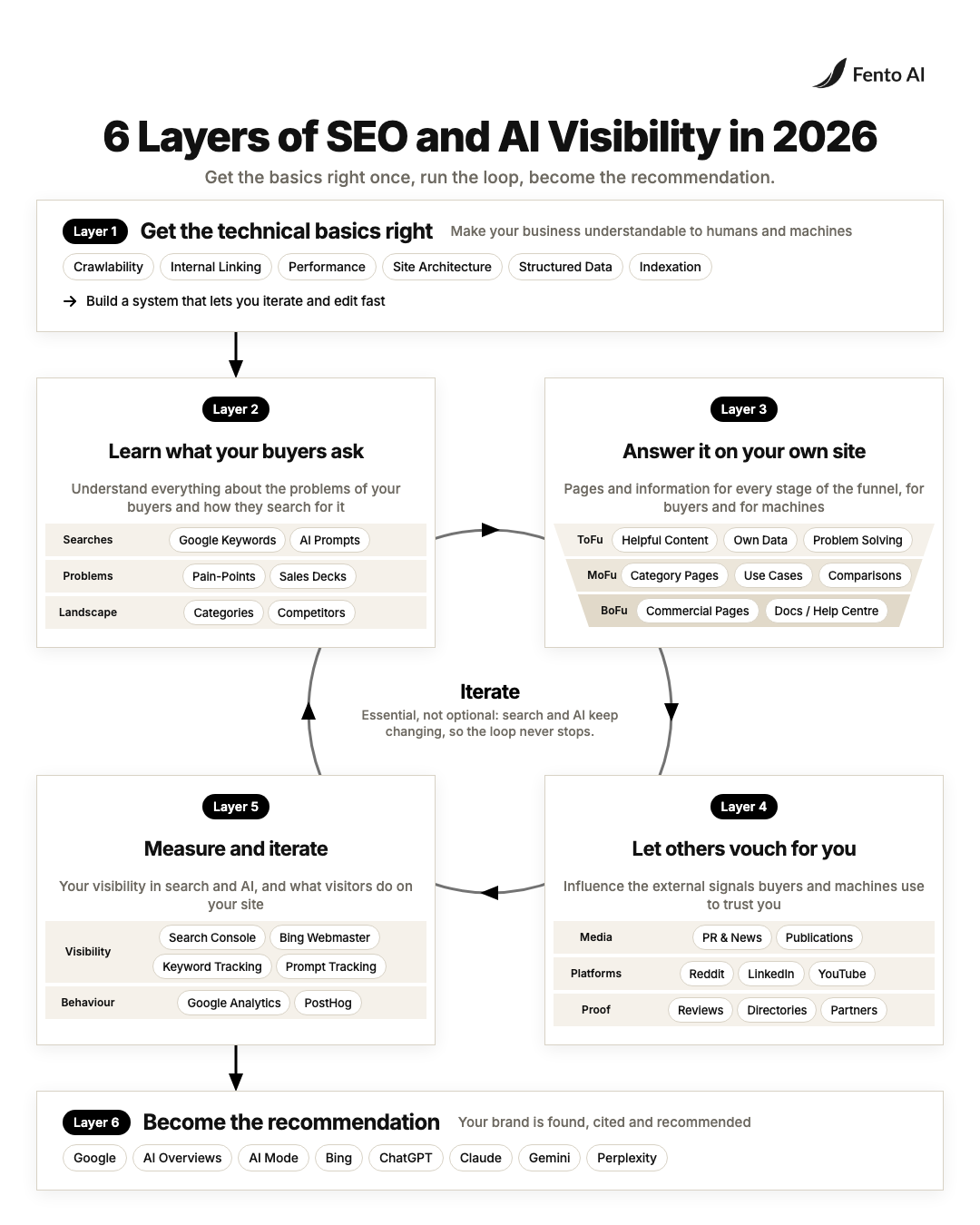
What has changed is the order and the goal. Success used to mean ranking, click, form. Today success means the machine has read, cited and recommended your page, and the human arrives with a finished shortlist. That takes a system, not a single ranking. We drew it as six layers.
Layer 1: Get the technical basics right once
Crawlability, internal linking, performance, site architecture, structured data, indexation. None of it is new, and still most B2B websites we see fail right here, only nobody notices because the site looks fine in a browser.
The decisive point for 2026: AI crawlers do not execute JavaScript. Vercel and MERJ analysed billions of requests and found that none of the major AI crawlers render JavaScript, not GPTBot, not ClaudeBot, not PerplexityBot. They partly download the script files but never run them. Whatever your framework loads in the browser after the fact does not exist for ChatGPT. Which of these bots are reading your site right now, and how to see it, is in our post on the AI bots reading your website.
Two things you can skip: Google says in the same guide that structured data is not required for generative search and that there is no special schema markup you need to add. New machine-readable files are not needed either. Why the much-sold llms.txt was never fetched by a single crawler in our bot log is worked out here.
What counts instead: every important page must be reachable through internal links in a few clicks, every page needs exactly one H1 and a clean heading hierarchy, and content in accordions or tabs must be in the HTML rather than generated on click.
And the line from the graphic we give every client: build a system that lets you iterate and edit fast. Layers 2 to 5 are a loop. If every text change triggers a ticket process with an agency, the loop does not run.
Layer 2: Learn what your buyers ask
This is where the loop starts, and where the biggest difference to classic SEO lies. Keyword research stays, but it is no longer enough.
The reason is query fan-out. Google describes in its documentation on AI features that AI Overviews and AI Mode break a question into multiple related searches across subtopics and data sources. Ahrefs measured it: AI Mode typically issues 5 to 11 searches for one prompt, 9 to 11 on average, and for almost a quarter of prompts 12 to 19. Your page does not have to match the user's question. It has to match one of those sub-questions. How the mechanism works in detail is in our post on fanout queries.
For research this means bringing three sources together, as in the graphic:
- Searches: Google keywords with volume, plus the prompts your audience types into ChatGPT, Gemini and Perplexity. How many phrasings you need for clean tracking is something we measured in an experiment of our own.
- Problems: The pain points from sales calls and the objections your sales decks answer. Those are the questions a buyer asks an AI before calling you.
- Landscape: The categories the AI sorts you into and the competitors it names next to you. You can query both directly by asking the systems.
One data point that shows how far most teams are here: according to Semrush's AI Visibility Index 2026, 45% of marketing leaders cannot measure their visibility in AI answers, and only 9% have the tools for it. Knowing the questions is an advantage the majority does not have.
Layer 3: Answer it on your own site
For every question from layer 2 you need a place on your website that answers it, for every stage of the buying process, for humans and for machines.
- Top of funnel: Helpful content, own data, solved problems. This is where AI systems cite most often, and where generic text delivers least. Google now runs a system that detects AI slop. Own numbers, own experience and clear positions are what remains.
- Middle: Category pages, use cases, comparisons. Almost every buyer now asks an AI "vendor A or vendor B". If you do not have the comparison page, a competitor or a review portal answers it.
- Bottom: Commercial pages, documentation, help centre. Pricing, integrations, requirements. Exactly what a buyer needs to cut the shortlist to two names.
Keep two findings in mind while writing. First, freshness: Seer Interactive analysed 47,097 citations from ChatGPT, Gemini and Perplexity and found that 75% of cited pages were updated within the last year, 88% within two years. Judged by publish date, only 42% are fresh. So it is updates, not new posts, that make the difference. Ahrefs sees the same picture across 17 million cited URLs: pages cited by AI assistants are 25.7% fresher on average than those in organic results.
Second, breadth instead of keyword density: Semrush added sections for 10 to 20 likely fan-out questions to four existing articles and raised their citations from two to five. Each section has to stand on its own, because the reranker scores passages, not pages.
And it pays measurably. Seer analysed 5.47 million queries from 53 brands: when a page is cited in the AI Overview, it earns 120% more organic clicks per impression than an uncited page under the same overview.
Our client Zeitmaker shows what this looks like in practice: three years of zero inbound, then within three months from 6 to 82 ranking keywords and from 8 to 128 content pages, with the first inbound lead after 20 days. The full story and three more B2B examples are in Does inbound really work in B2B?
Layer 4: Let others vouch for you
The AI cites your page when it believes it. And whether it believes it is largely decided outside your domain.
Ahrefs studied 75,000 brands and measured which factors correlate with AI visibility. The result across ChatGPT, AI Mode and AI Overviews: YouTube mentions correlate most strongly at around 0.74, web mentions at 0.66 to 0.71, backlinks considerably weaker. Brands in the top quartile for web mentions are named more than ten times as often in AI Overviews as the next quartile.
The citation studies show which platforms count. Peec AI analysed 30 million cited sources: Reddit, YouTube and LinkedIn are the most-cited domains across five AI search engines. For B2B, LinkedIn is the interesting line. Semrush counts LinkedIn in 14.3% of all ChatGPT Search answers and 13.5% in AI Mode, the second most cited domain overall, ahead of Wikipedia and YouTube. For professional queries, Profound even sees LinkedIn in first place, with a growing share of posts rather than profiles.
For your company this means taking the three rows from the graphic seriously:
- Media: Trade press and publications where your company appears with name and topic. Not for the link, but for the mention.
- Platforms: Answers in the Reddit threads of your niche, LinkedIn posts with substance instead of company announcements, YouTube videos that solve a concrete question.
- Proof: Reviews on G2, Capterra or OMR Reviews, entries in directories, partner pages that list you. Those are the pages an AI reads for "vendors for X".
Layer 5: Measure and iterate
What you do not measure you cannot repeat, and the loop lives on repetition. In 2026, for the first time, there is real data for this instead of estimates.
- Google Search Console: The generative AI report launched on 3 June 2026 and has been available for all websites worldwide since 31 August. It shows impressions from AI Overviews and AI Mode by page, country and date. It does not include clicks yet.
- Bing Webmaster Tools: The AI Performance report has shown Copilot citations and the grounding queries the AI used to retrieve your content since 10 February 2026. Since June it adds intents, topics and citation share.
- Analytics: ChatGPT appends a parameter to links so that visitors show up in GA4 with the source chatgpt.com, while Perplexity and Gemini arrive as referrals. In PostHog you additionally see what those visitors do on the site.
- Tracking: A rank tracker for the keywords from layer 2 and a prompt tracker for the AI questions. Together they show which page appears in which system how often.
How to read the Google and Bing reports in detail is in our post on AI search visibility in Google and Bing.
One more thing about expectations: in an Ahrefs poll of 3,680 SEO practitioners, most named three to six months until SEO shows results. Measurement has to be in place before that, otherwise you will not see the rise when it comes and will switch the channel off just before it starts carrying.
Layer 6: Become the recommendation
The last layer is not a to-do but the outcome of the five before it. Your brand is found in Google, cited in AI Overviews and AI Mode, recommended in Bing, ChatGPT, Claude, Gemini and Perplexity. And a buyer who researched with an AI arrives with your name on the shortlist.
Working the layers in isolation does not get you here. Semrush measured in its 2026 index that 81% of companies with an integrated SEO and AI strategy report more traffic or leads from AI platforms, against 36% with siloed teams. According to HubSpot's State of Marketing 2026, 40.6% of marketers name updating their SEO for search changes as one of their top topics, and nearly 30% report decreased search traffic. The gap between the two groups is your opportunity.
The six layers at a glance
| Layer | Core question | Metric |
|---|---|---|
| 1 Technical basics | Can every machine read every important page? | Indexed pages, bot log, Core Web Vitals |
| 2 Buyer questions | Which questions and sub-questions do buyers ask? | Keyword and prompt list with coverage |
| 3 Own answers | Is there a page for every question that answers it? | Rankings, citations, last-updated date |
| 4 External signals | Who besides you says you are the solution? | Mentions, reviews, platform presence |
| 5 Measurement | Which page shows up where, and what do visitors do? | Search Console, Bing, analytics, trackers |
| 6 Recommendation | Is your name on the shortlist? | Enquiries that already know you |
Where to start this week
- Bot check: Open your most important product page with JavaScript disabled. Whatever is missing is missing for ChatGPT too.
- Ten questions: Collect the ten questions buyers asked in sales calls last month. Check whether your website answers every single one.
- Ask the AI: Ask ChatGPT, Gemini and Perplexity "Which vendors for [your category] are there in Germany?" and note who gets named and which sources are cited.
- Switch on the reports: Set up Search Console and Bing Webmaster Tools if you have not, and open the AI report. It shows what is already happening today.
- Update one page: Take the post with the most impressions and add the three sub-questions it does not answer yet.
That is one pass through the loop. From the second one on, it gets faster.
We build exactly this system for B2B companies in tech and industry: the foundation done right once, the loop as an ongoing process, measurement across Google, Bing and the AI engines. How we go about it is on our services page.
Sources: Google: Alphabet Q2 2026 · Google: AI Mode expands to new languages and locations · Search Engine Land: ChatGPT 900 million weekly users · Similarweb: AI referral traffic by industry · Sistrix: AI Overviews in Germany · Ahrefs: AI Overviews reduce clicks, update · SparkToro: Zero-click 2026 · Semrush: AI search traffic study · Ahrefs: AI search conversions · Demand Gen Report: Gartner on B2B buying · 6sense: GenAI and LLMs in B2B buying · Forrester: State of Business Buying 2026 · Google: AI optimization guide · Google: AI features and your website · Vercel: The rise of the AI crawler · Ahrefs: Query fan-out · Semrush: AI Visibility Index 2026 · Seer: Content recency and AI visibility 2026 · Ahrefs: Do AI assistants prefer fresh content · Semrush: Query fan-out experiment · Seer: AIO impact on CTR 2026 · Ahrefs: AI brand visibility correlations · Ahrefs: AI Overview brand correlation · Search Engine Land: Peec AI citation study · Semrush: LinkedIn AI visibility study · Profound: LinkedIn in AI search · Google: New controls and insights for website owners · Bing: AI Performance in Webmaster Tools · Bing: Intents, Topics, Citation Share · Seer: AI sites sending traffic · Ahrefs: How long does SEO take · HubSpot: State of Marketing 2026